Research and Advocacy
-
Research and Advocacy -
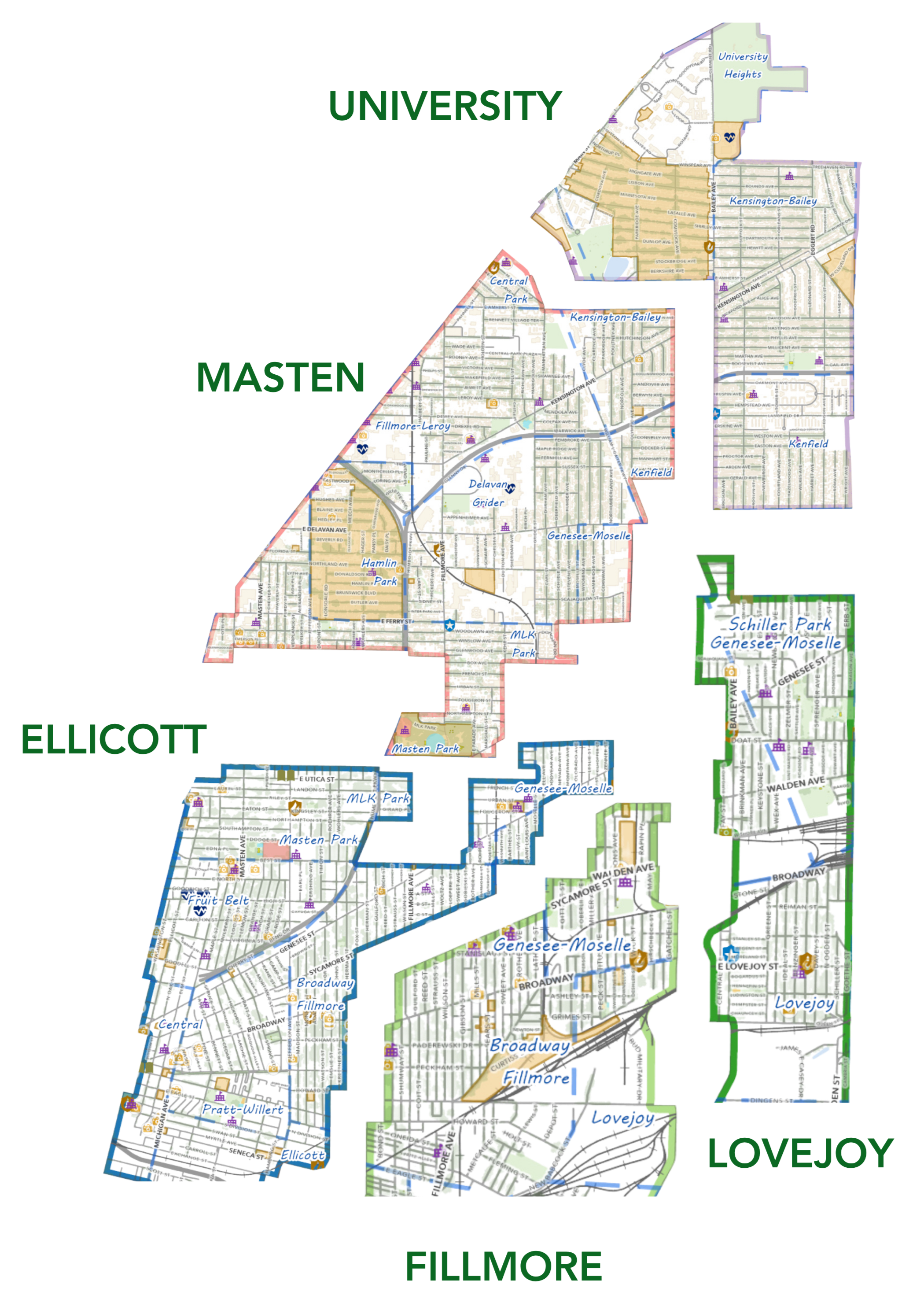
Why The East Side of Buffalo, NY?
The East Side of Buffalo, New York, is a culturally rich area home to historic African American communities. It is comprised of 14 neighborhoods located east of Main Street, including Broadway-Fillmore, Cold Springs, Delavan-Grider, Ellicott, Fruit Belt, Fillmore-Leroy, Genesee-Moselle, Hamlin Park, Kensington-Bailey, Kenfield, Lovejoy, Masten Park, MLK Park, and Schiller Park.
The East Side has long faced environmental and health disparities due to industrial pollution, highway construction, economic disinvestment, and systemic neglect. Historically home to sources of pollution like General Motors, American Axle, the historic New York Central mainline, now the CSX Buffalo Terminal Subdivision / Frontier Yard, and the Kensington Expressway, the area suffers from lingering contamination and ecological degradation that disproportionately impact its predominantly Black, South Asian, and Latino/a/x communities. This has resulted in heightened exposure to pollutants, contributing to health issues such as asthma, which affects 11% of children and 7% of adults in the area. Additionally, the East Side has over 7,000 vacant lots, exacerbating urban decay and limiting opportunities for revitalization.
Compounding these challenges, the East Side is classified as food insecure, restricting access to fresh and affordable food while increasing rates of obesity and diabetes. The lack of green spaces and deforestation intensify environmental risks, contributing to poor air quality and extreme heat effects. Climate vulnerabilities, including intensifying blizzards, extreme lake-effect snow, and aging infrastructure in need of constant upkeep, further threaten the well-being of East Side residents. Addressing these disparities requires sustained investment, grassroots organizing, and community-led action to reclaim land, improve living conditions, and build a healthier, more just future.
Magavern, S. (2023). Using publicly-owned vacant land to advance sustainability and equity in Buffalo, New York. Partnership for the Public Good. https://ppgbuffalo.org/buffalo-commons/library/resource:using-publicly-owned-vacant-land-to-advance-sustainability-and-equity-in-buffalo-new-york/

Wagner's Redlining Map of Buffalo, 1937

EPA EJ Screen Map Density of People of Color in Buffalo Census Tracts Overlayed w/ EPA regulated sites 2024

EPA EJ Screen Community Report of East Side of Buffalo Census Tracts 2024
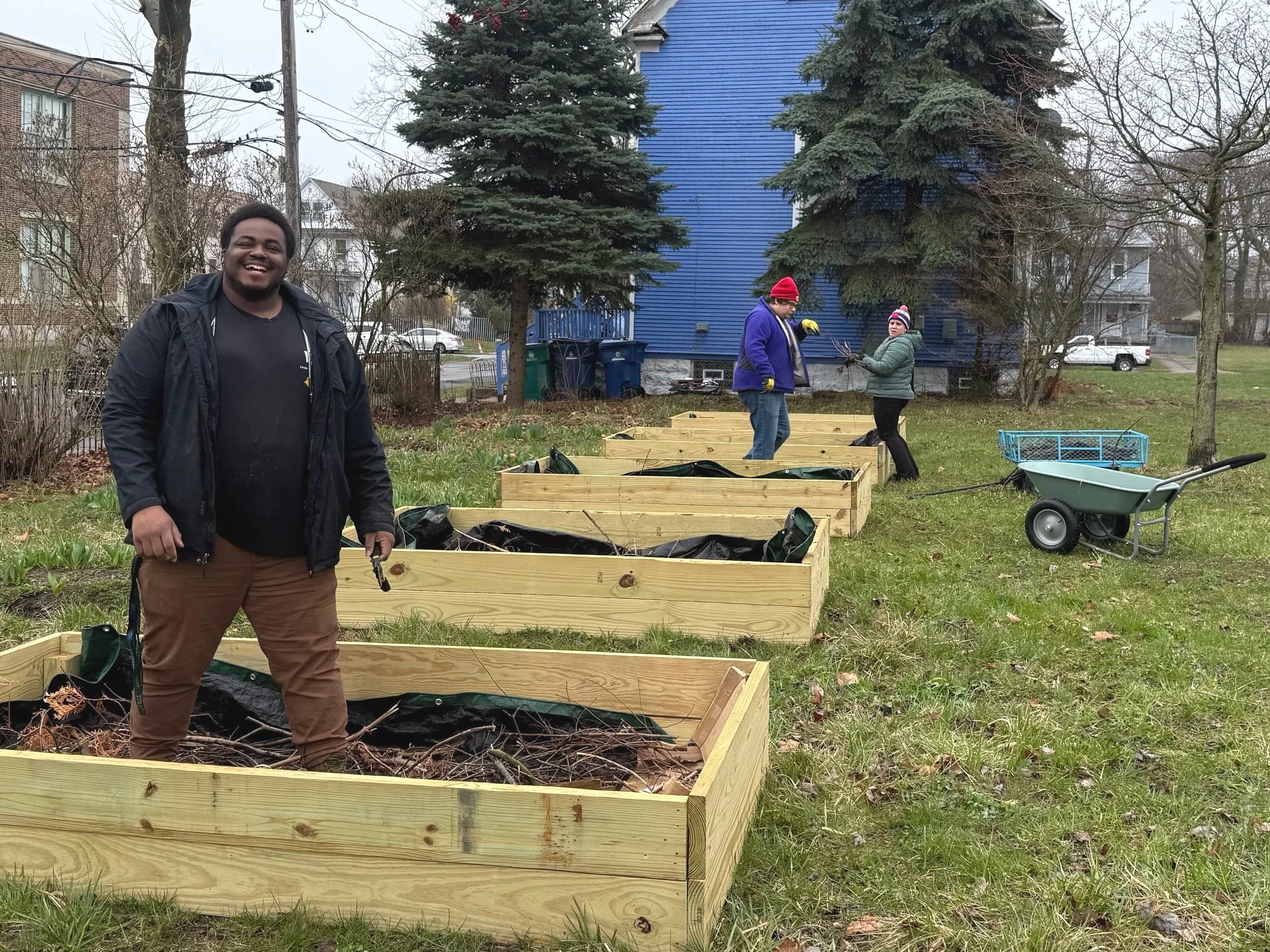
Reclaim, Tend, Remain / Hold The Ground
Community Campaign for Equitable Land Use and Community Ownership in Buffalo
We are running a community organizing campaign to shift power in land governance in Buffalo, NY, from city hall and speculative investors to low-income Black and brown residents of historically redlined neighborhoods. Through community land trust expansion, vacant land disposition policy reform, and a political accountability structure, we are building resident power to reclaim community control of land.
Front 1: Community Land Trust Expansion
ESS is organizing East Side residents to permanently remove land from the speculative market through a resident-governed Community Land Trust, negotiating directly with the City of Buffalo and BENLIC for zero or below-market transfers of vacant parcels back into community hands.
Front 2: Land Disposition Policy Reform
ESS is advancing a Community Benefit and Right of First Refusal ordinance through the Buffalo Common Council that would legally require the city to offer vacant parcels to community land trusts and resident cooperatives before any open-market transfer.
Front 3: Political Accountability Structure
ESS is building the electoral and civic infrastructure to make land justice a constituency issue that propels East Side council to action, through a candidate scorecard, coordinated public testimony, and a dues-paying Land Justice Coalition across WNY.
1. Buffalo's vacancy crisis is one of the worst among all Rust Belt cities. According to the 2000 U.S. Census, Buffalo had more vacant properties than Cleveland, Detroit, Pittsburgh, and Philadelphia combined in that census year. 15.7% of all housing units were vacant, and 43.7% of those were classified as chronic vacancies. USPS delivery data from that same period showed that 1/5 addresses in Buffalo was classified as vacant or no-stat. (Wilkinson)
2. Vacant land costs cities money they don't have. Detroit spent $800,000 annually just to clean vacant lots. Trenton, NJ spent between $500,000 - $1 million per year through the 1990s on maintenance alone, before factoring in demolition or environmental remediation. These are not hypothetical costs. They are recurring municipal expenditures that produce no community return. (Wilkinson)
3. Community-controlled land reclamation works and produces measurable results. Since 1988, the Dudley Street Neighborhood Initiative in Boston gained control of approximately 1,300 vacant lots and properties, converting roughly half into nearly 300 new homes, 300 rehabbed homes, urban agriculture, a commercial greenhouse, and community green space. Homes purchased through the land trust rarely went into foreclosure. (Hexter, Greenwald, and Petrus)
4. Grassroots food infrastructure scales when properly resourced. Detroit's Garden Resource Program grew to 1,244 gardens by 2013, including 748 family gardens, 55 school gardens, and 76 market gardens, with scores of growers selling produce cooperatively at Eastern Market and beyond. This network was built primarily through community collaboration, federal grants, and private philanthropy, with minimal sustained city investment. (Pothukuchi)
5. Anchor institution investment without community accountability produces displacement, not development. The Buffalo Niagara Medical Campus sits on 120 acres adjacent to downtown, employs 17,000 people, and saw over $800 million in institutional construction in surrounding corridors. Focus group participants from the Fruit Belt, the neighborhood directly adjacent to the campus, reported that not one dollar of that investment was directed toward their neighborhood or toward minority-owned businesses. Between 2010 and 2016, the three study neighborhoods lost 15.7% of their total population and 29.9% of their African American residents. (Silverman et al.)
Hexter, K. W., Greenwald, C., & Petrus, M. H. (2008). Sustainable reuse strategies for vacant and abandoned properties.
Pothukuchi, K. (2015). Five Decades of Community Food Planning in Detroit: City and Grassroots, Growth and Equity. Journal of Planning Education and Research, 35(4), 419–434. https://doi.org/10.1177/0739456X15586630
Silverman, R. M., Taylor Jr, H. L., Yin, L., Miller, C., & Buggs, P. (2019). Place making as a form of place taking: Residential displacement and grassroots resistance to institutional encroachment in Buffalo, New York. Journal of Place Management and Development, 12(4), 566–580. https://doi.org/10.1108/JPMD-11-2018-0082
Wilkinson, L. (2011). Vacant property: strategies for redevelopment in the contemporary city. Georgia Institute of Technology: Atlanta, GA, USA, 39.
The Data Tells A Story